
Female Pattern Hair Loss
Androgenic Alopecia in Women: Causes, Treatments and What Actually Works
By BJ, PharmD, RPh | BeautiPharm
4/3/20265 min read
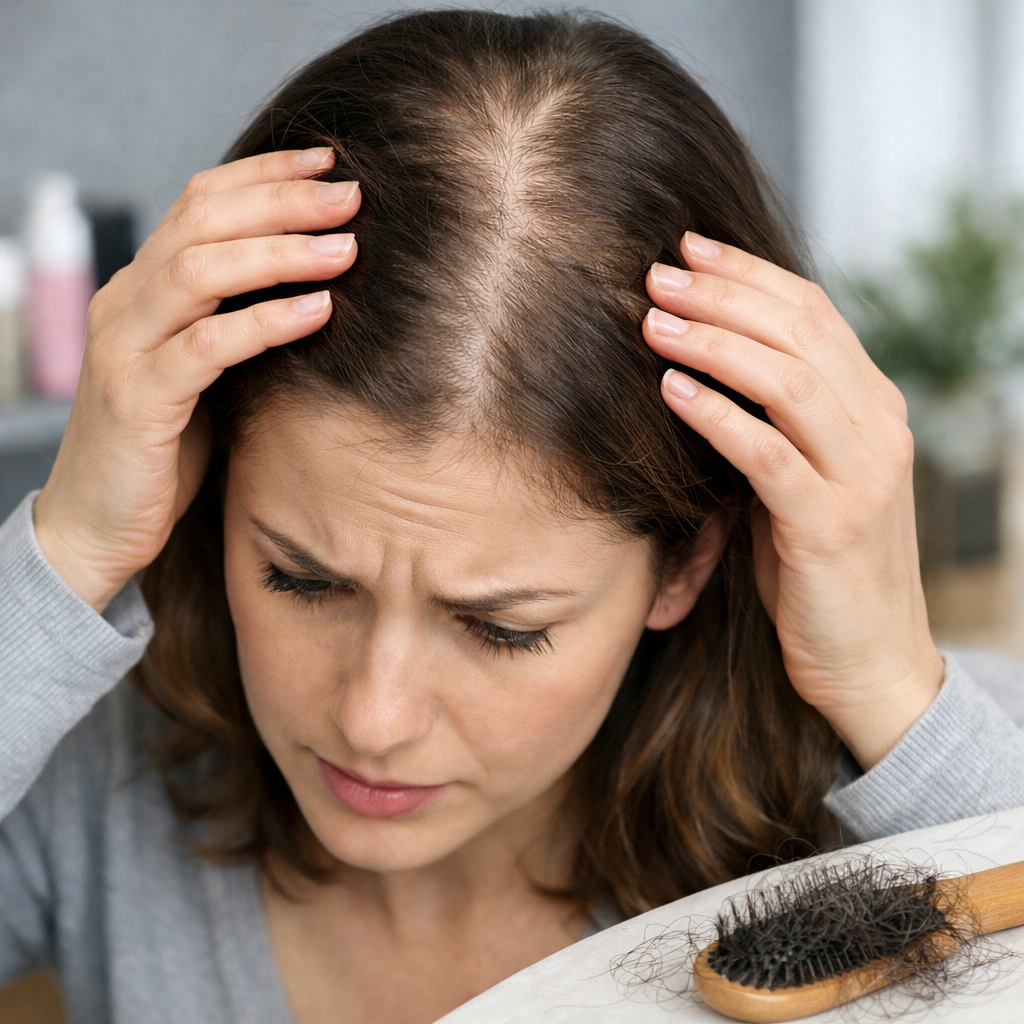
Let's talk about something nobody wants to talk about: watching your hair thin and not knowing why, what to do, or whether it's ever going to stop.
If you've noticed more hair in your brush, a wider part, or thinning at your crown — you're not imagining it. And you're not alone. Androgenic alopecia (AGA) is the most common cause of hair loss in both men and women. As a pharmacist, I see patients confused about this every single week. So let me break it all down — the real science, the real options, and what actually matters.
What Is Androgenic Alopecia?
Androgenic alopecia, also called pattern hair loss, is a progressive condition where hair follicles gradually shrink over time, producing thinner, shorter, weaker strands — until eventually they stop producing hair at all.
In men, it's called male pattern baldness — the classic receding hairline and thinning at the crown forming an "M" shape.
In women, it looks different. The hairline usually stays intact, but the part widens and the top of the scalp becomes noticeably thinner. Women rarely go completely bald, but the thinning can be just as distressing.
Here's the important thing: this is not just a cosmetic issue. It's a biological process driven by hormones, genetics, and — more recently discovered — inflammation.
The Real Cause: It's Not Just "Bad Genes"
Most people are told "it runs in your family, nothing you can do." That's an oversimplification, and honestly, it's not helpful.
Yes, genetics play a role — a significant one. But the actual mechanism is more specific than that, and understanding it matters because it determines what treatments work.
The DHT Problem
The main driver of androgenic alopecia is a hormone called dihydrotestosterone — DHT.
Here's how it works:
Your body produces testosterone (yes, women have testosterone too — just in smaller amounts)
An enzyme called 5-alpha reductase converts testosterone into DHT
DHT binds to androgen receptors in your hair follicles
This binding shortens the hair's growth phase (called the anagen phase) and extends the resting phase
Over repeated cycles, follicles shrink — a process called miniaturization
Eventually, follicles stop producing visible hair entirely
The follicles most sensitive to DHT are at the top and front of the scalp — which is exactly why those areas thin first. The back and sides of the scalp have fewer androgen receptors, which is why that hair is usually spared.
Why Women Are Different
In men, DHT is the clear main villain. In women, it's more complicated.
Some women with AGA have elevated DHT levels — but many don't. This is why female pattern hair loss is harder to diagnose and treat. Other hormonal factors, including estrogen decline (especially after menopause), insulin resistance, and thyroid dysfunction, all play a role in how sensitive follicles are to androgens.
This is also why androgenic alopecia in women is closely linked to PCOS — both conditions share the same hormonal imbalance at their root.
The Hair Growth Cycle (And Why It Matters)
To understand why treatment takes so long, you need to understand the hair growth cycle.
Every hair on your head goes through four phases:
Anagen (growth phase): Lasts 2–7 years. This determines how long your hair can grow. In AGA, this phase gets shorter and shorter with each cycle.
Catagen (transition phase): About 2 weeks. The follicle detaches from the blood supply.
Telogen (resting phase): About 3 months. The hair just sits there before falling out.
Exogen (shedding phase): The hair sheds and the cycle restarts.
In a healthy scalp, about 85–90% of your hair is in the anagen phase at any given time. In androgenic alopecia, that ratio shifts — more hairs spend more time resting and shedding, and less time growing.
This is why hair loss can feel sudden — a stressor, hormonal shift, or illness can push a large group of follicles into the telogen phase at once (called telogen effluvium), which unmasks an underlying AGA that was already quietly progressing.
How Is It Diagnosed?
Androgenic alopecia is usually diagnosed clinically — meaning a doctor or dermatologist looks at the pattern of your hair loss and your history.
Two scales are commonly used:
The Norwood-Hamilton Scale for men (grades hairline recession and crown thinning)
The Ludwig Scale for women (grades diffuse thinning at the crown)
A trichoscopy or dermoscopy (a magnified examination of the scalp) can confirm miniaturized follicles without needing a biopsy.
Blood tests your doctor should check:
Ferritin (iron stores — low ferritin is a hugely overlooked cause of hair loss in women)
Thyroid function (TSH, free T3, free T4)
Androgens (DHEA-S, testosterone, free testosterone)
Vitamin D
B12
As a pharmacist, I always encourage patients to ask for a full panel before assuming it's purely genetic. Nutrient deficiencies can look identical to pattern hair loss — and they're fixable.
The Inflammation Factor — What Most People Don't Know
Here's something that doesn't get talked about enough: inflammation plays a significant role in AGA.
Recent research has shown that there is chronic low-grade inflammation around miniaturized hair follicles. Immune cells accumulate around the follicle, releasing inflammatory messengers (cytokines) that damage the follicle structure over time. In advanced cases, this can lead to fibrosis — scarring around the follicle — which makes hair loss permanent.
This is why scalp health matters. Conditions like seborrheic dermatitis, dandruff, and scalp buildup aren't just cosmetic — they can worsen the inflammatory environment around your follicles.
What Are the Topical Treatment Options?
Let me be clear: there is no cure for androgenic alopecia. But there are treatments that slow progression, and in some cases partially reverse it — especially when started early.
1. Minoxidil (Rogaine)
The most widely used topical treatment for both men and women. It works by prolonging the anagen (growth) phase and improving blood flow to the follicle. It does not address the DHT problem — it buys your follicles time. It requires consistent, lifelong use. Stopping it means the hair loss returns.
2. Aminexil (found in products like Kérastase and L'Oréal)
Aminexil works differently — it targets the rigidification of collagen around the hair follicle, which is one of the processes that accelerates miniaturization. It doesn't block DHT, but it helps maintain follicle flexibility and anchoring. A great option for early intervention and for those who want a cosmetic/OTC approach alongside medical treatment. I'll have a dedicated review post on aminexil products coming soon.
3. Scalp Care and Anti-Inflammatory Approaches
Given the inflammation component, keeping your scalp healthy genuinely matters. Regular gentle cleansing, addressing dandruff, scalp massages to improve circulation, and avoiding harsh chemical treatments all support a healthier follicle environment.
Supplements That Support Hair Health
While no supplement will reverse androgenic alopecia on its own, correcting deficiencies can make a meaningful difference — especially if deficiencies are contributing to or accelerating the loss.
Key nutrients to consider:
Iron / Ferritin: Especially important for women. Low ferritin is one of the most commonly missed contributors to female hair loss. Your ferritin should be above 70 ng/mL for optimal hair growth — most labs flag deficiency only below 12.
Zinc: Involved in 5-alpha reductase regulation. Deficiency can worsen AGA.
Biotin: Deficiency is rare but does cause hair loss. Most people get enough from diet — supplement only if actually deficient.
Vitamin D: Receptors for vitamin D are found in hair follicles. Deficiency is extremely common in Canada.
Collagen peptides: Support the structural integrity of the scalp and follicle.
I'll link my specific product recommendations in the Shop My Picks section — chosen with a pharmacist's eye for quality, formulation, and value.
When to See a Doctor
Please don't just buy products and hope for the best. See a dermatologist or your doctor if:
Your hair loss is sudden or rapid
You notice patchy loss (this may be alopecia areata, a different condition)
You have other symptoms — acne, irregular periods, facial hair (could be PCOS)
You're shedding more than 100–150 hairs a day consistently
Your scalp is itchy, flaky, or inflamed
Early intervention matters. Once follicles are permanently miniaturized, no topical treatment can bring them back.
The Pharmacist's Bottom Line
Androgenic alopecia is real, it's common, and it's driven by a combination of genetics, hormones, and inflammation — not just "bad luck."
The good news: you have options. The earlier you act, the more options you have.
Coming up on BeautiPharm:
✦ Kérastase Aminexil — full pharmacist review
✦ L'Oréal Aminexil vs Kérastase — which one is worth it?
✦ The supplements I actually recommend for hair loss
Have questions? Drop them in the comments or reach out at hello@beautipharm.ca.
Disclaimer: This post is for educational purposes only and does not constitute medical advice. Always consult a healthcare provider for diagnosis and treatment of hair loss.
— BJ, PharmD, RPh